By Dennis “DJ” Schmitt, Founder & CEO of Neuro20 Technologies
OLDSMAR, Fla., July 24, 2026 — Every year, millions of people begin the long journey of recovering from a stroke, spinal cord injury, traumatic brain injury, Parkinson’s disease, multiple sclerosis, or another neurological condition. While modern medicine has made remarkable advances in helping patients survive these life-changing events, recovery presents a different challenge, one that often extends months or even years beyond the walls of a rehabilitation facility.
For Dennis “DJ” Schmitt, founder and CEO of Neuro20 Technologies, this challenge became impossible to ignore.
“The neurological condition doesn’t stop simply because a therapy appointment ends,” Schmitt says. “Yet our healthcare system is largely built around episodic care. That’s where we believe one of the greatest opportunities in neurological rehabilitation exists.”
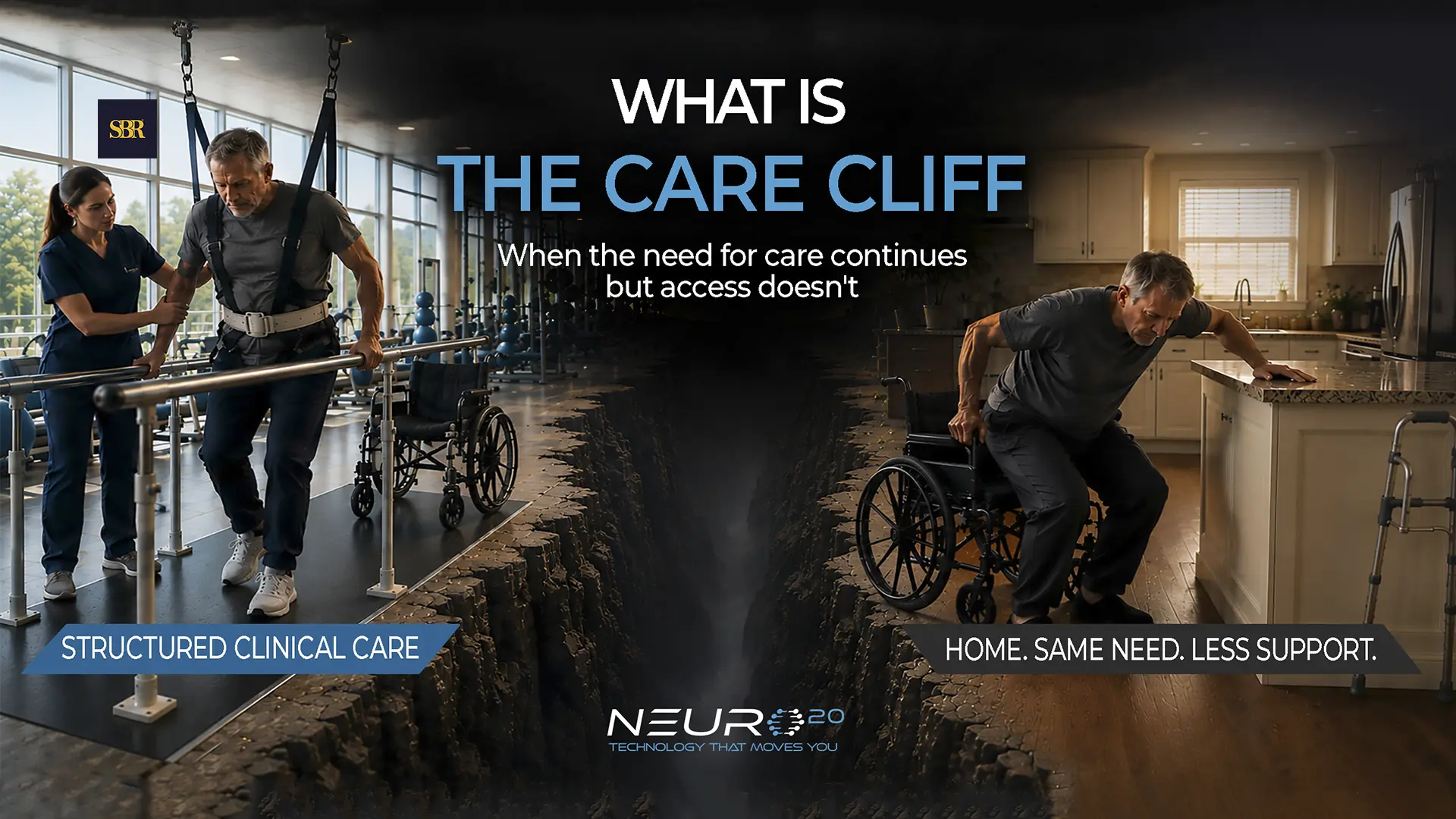
Neuro20 has given this challenge a name: the Care Cliff.
It describes the point where a patient’s need for neurological intervention remains constant while access to structured, clinician-directed rehabilitation declines significantly. Patients who may receive several hours of therapy each day during inpatient rehabilitation often transition to only a handful of outpatient visits each month. Although therapists continue to do extraordinary work, the reality is that healthcare resources are finite, clinician shortages continue to grow, and patients frequently need more support than the traditional care model can provide.
Rather than viewing this as a failure of healthcare professionals, Neuro20 sees it as an opportunity to rethink how neurological care is delivered.
“Our mission has never been to replace therapists,” Schmitt explains. “Our mission is to help extend their reach.”
That philosophy has shaped the development of the company’s FDA-cleared Whole-Body Electrical Neuromuscular Modulation (ENM) platform—a technology designed to support clinician-directed neurological rehabilitation while creating continuity between the clinic and the home.
Unlike traditional approaches that focus on isolated intervention, Neuro20 was engineered around the understanding that human movement is inherently coordinated. Walking, standing, reaching, balancing, and performing everyday tasks require multiple muscle groups working together in carefully timed patterns. Recovery, the company believes, should reflect that same complexity.
The Neuro20 PRO System combines an intelligent wearable Smart Suit with 20 integrated electrodes organized into nine independently controlled channels. Clinicians can individualize treatment while patients perform meaningful functional activities such as gait training, sit-to-stand exercises, balance activities, cycling, and other task-specific movement patterns.
The emphasis, however, is not on the technology itself.
“The platform is simply the tool,” Schmitt says. “The real objective is enabling better neurological care.”
That distinction represents an important shift in how Neuro20 positions itself within healthcare. Rather than describing itself as a medical technology company alone, Neuro20 increasingly sees itself as building the infrastructure for continuous neurological care.
The company believes neurological rehabilitation is entering a period of significant transformation. As medical advances continue improving survival rates following neurological injury and disease, healthcare providers are increasingly challenged to support long-term recovery rather than short-term intervention.
“We’ve become exceptionally good at saving lives,” Schmitt says. “The next challenge is helping people live those lives as fully and independently as possible.”
This evolution is occurring at the same time healthcare systems are navigating workforce shortages, growing patient populations, reimbursement pressures, and increasing demand for care delivered outside traditional facilities.
Neuro20 believes these trends point toward a future where rehabilitation becomes more connected, more personalized, and more continuous.
That vision extends well beyond hardware.
The company is developing a broader ecosystem that connects rehabilitation clinics, physicians, patients, and home-based care through intelligent software, secure clinical data, and responsible artificial intelligence.
Importantly, Schmitt emphasizes that artificial intelligence is intended to enhance—not replace—clinical decision-making.
“We don’t believe AI should practice medicine,” he says. “We believe it should organize information, identify meaningful trends, and help clinicians make better-informed decisions while remaining firmly in control of patient care.”
Building a platform capable of supporting that vision has required far more than engineering expertise.
Like many emerging healthcare companies, Neuro20 has navigated regulatory requirements, quality systems, clinical validation, implementation, education, and the challenge of introducing an entirely new approach into an understandably cautious healthcare environment.

Image credit: Neuro20 Technologies
Healthcare providers demand evidence before adopting new technologies, and rightly so.
“We’ve spent a tremendous amount of time listening,” Schmitt says. “The feedback we’ve received from therapists, physicians, researchers, rehabilitation hospitals, and veterans’ healthcare organizations has helped shape every stage of our development.”
That collaborative approach has become central to Neuro20’s philosophy.
The company works closely with rehabilitation hospitals, outpatient providers, researchers, academic institutions, and veterans’ healthcare organizations, viewing each relationship as a partnership rather than a customer transaction. Education, onboarding, clinical training, protocol development, and ongoing support are considered just as important as the technology itself.
Behind those efforts is a multidisciplinary team of engineers, physicians, therapists, software developers, regulatory professionals, operations specialists, researchers, and customer support personnel.
Many members of the organization also bring personal experience with neurological rehabilitation, military service, or long-term patient care, perspectives that continue influencing both the company’s culture and its direction.
Looking ahead, Neuro20’s priorities remain focused on expanding clinical evidence, strengthening reimbursement pathways, increasing patient access, and continuing to develop the connected technologies that support continuous neurological care.
The company is actively investing in multicenter clinical research while advancing software capabilities, remote monitoring tools, and intelligent data platforms designed to help clinicians better understand patient progress across both clinical and home environments.
Yet despite those ambitions, Schmitt says success will ultimately be measured by something much simpler.
“We don’t want to become known simply as another rehabilitation technology company,” he says. “If five years from now people say Neuro20 helped redefine what continuous neurological care can look like, we’ll know we’ve accomplished something meaningful.”
For Neuro20, the Care Cliff is more than a phrase. It represents a challenge shared by clinicians, patients, and healthcare systems alike.
The company’s vision is not to replace rehabilitation, but to strengthen it; to help ensure that neurological recovery is no longer limited by the schedule of a therapy appointment.
As healthcare continues evolving beyond episodic treatment toward more connected models of care, Neuro20 hopes to play an important role in shaping what comes next.
Because neurological recovery doesn’t end when therapy does, and perhaps neither should neurological care.
For more information, visit neuro20.com.
For Neuro20, the goal is not simply to introduce another rehabilitation technology. The goal is to help build a model of care where clinicians remain central, patients remain supported, and neurological recovery is no longer limited by the walls of the clinic.