By C. Brian Hesse | Co-Founder & CEO of The Perennial Group Inc. and Founder of Adaptiq LLC
Aluminum plays a significant role in the US economy. It drives our largest industries, such as transportation, construction, packaging, and defense, to the broadest levels, as well as our transformation to a circular economy. From a defense perspective, maintaining a strong US manufacturing sector to ensure the strength of our armed forces without dependency on foreign aluminum must be a strong priority. It goes deeper than this: the US Aluminum Industry supports hundreds of thousands of jobs, both directly and indirectly, in the US.
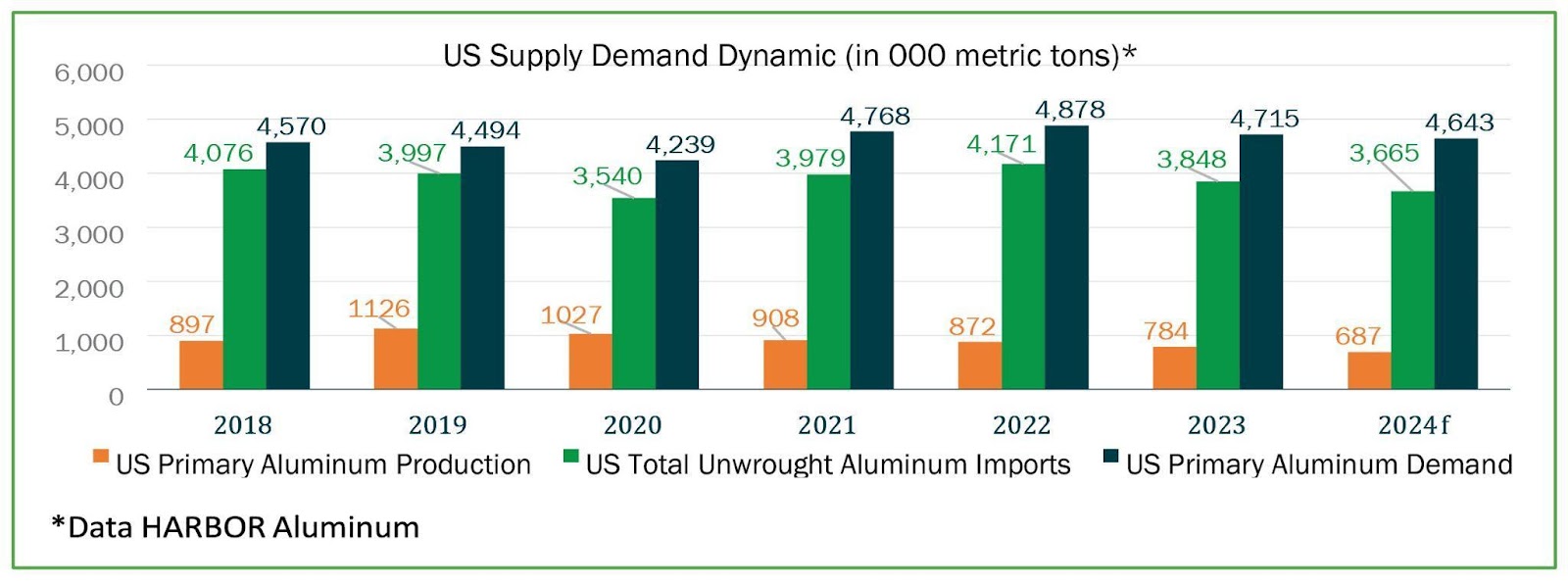
You may think, if aluminum is critical to the US, why did we import 3.8 million metric tons ($11.4 billion) of aluminum in 2023? According to HARBOR Aluminum (the US go-to source for current and accurate aluminum statistics), that is exactly what we have done and continue to do: imported 3.8 million metric tons of aluminum to meet the US demand for 4.7 million metric tons. Why? Because US production has dramatically shrunk over the last decades, and the US can only produce 687,000 metric tons, according to data obtained from HARBOR Aluminum.
According to Industrious Labs¹, the US produced 7.4 million tons of aluminum in 1999. That is more than ten times the amount American manufacturers produce today. This is not reassuring to anyone concerned about the strategic independence of this critical industrial infrastructure in the US economy. They say a picture is worth a thousand words…or millions of tons!
According to Canary Media2 on March 19, 2024:
“Faced with spiking energy costs and increased competition from China, however, Alcoa and other U.S. producers have significantly reduced their domestic aluminum production. In the last 18 months, three of America’s aluminum plants have scaled back. Alcoa closed its Intalco smelter in Ferndale, Washington, while operations were curtailed at Century Aluminum’s plant in Hawesville, Kentucky, and most recently, the Magnitude 7 Metals smelter in Marston, Missouri.
Together, the facilities represented over half of the U.S. capacity for producing primary, or non-recycled, aluminum. Today, there are four smelters, including the ones above, and in 1999, there were thirty.”
My critical concern is that America does not have enough aluminum capacity to meet domestic demand, and buying billions of pounds from other countries creates an enormous vulnerability to U.S. security. Furthermore, the addition of geopolitical issues, import tariffs, and the new administration’s executive orders imposing new import tariffs on Canada and China only exacerbate the situation. The U.S. is creating a messy scenario that threatens the supply chain predictability of many U.S. manufacturers.
The Section 232 Tariff, a 10% tax on aluminum imported from other countries (with a couple of exceptions), has not worked and will not work. This tax has the opposite impact of its publicized benefits.
1) Domestic production did not increase (refer to the chart above).
2) Jobs were not created.
3) The tariff was passed on to manufacturers, decreasing the global competitiveness.
4) Ultimately, U.S. consumers paid more for end products.
5) Other countries placed retaliatory tariffs on the US.
6) The US has become less attractive to offshore suppliers as a home for their metal.
 According to America Action Form3, the estimated cost of the U.S.-imposed tariffs annually is $2.1 billion for aluminum. This is $2.1 billion that has been paid to the U.S. government each year since 2018. Do the math: it totals $14.7 billion through 2024. For $14.7 billion, we could have increased U.S. aluminum production by 1.47 million metric tons. We could have been much closer to becoming self-sufficient as a country!
We live in a complex world where nothing is isolated. Geopolitical issues, war, threats of port strikes, waterway disruptions, volatile shipping costs, and burdensome executive orders underscore the urgency for investment in U.S. aluminum manufacturing. This critical need for investment is compounded once we look at the aluminums sector’s growth projections.
According to NMCS4 (Next Move Consulting Strategy), “The U.S. aluminum market size was valued at USD 12.47 billion in 2023 and is predicted to reach USD 17.13 billion by 2030, at a CAGR of 4.6% from 2024 to 2030. The growth is driven by increasing demand in key sectors such as automotive (especially EVs), construction, packaging, and aerospace. This growth is further steered by the push for green manufacturing in the U.S.”
Considering a conservative growth rate of 3-5% per year, the U.S. needs new production investments of 100K to 300K metric tons per year. This is barely enough to cover the growth of the industry, let alone replace the production gap the U.S. has self-inflicted over many decades.
The United States should relax tariffs on aluminum producers of raw materials. This should be targeted at countries that share similar values and interests with the U.S. and are considered allies. Relaxing tariffs would reward our domestic industry, allowing it to be more competitive at home and globally.
A career spanning decades in the aluminum industry has given me a comprehensive and realistic understanding of the difficulties U.S. manufacturers face, including supply chain unpredictability, soaring prices, and decisions regarding whether to purchase domestically or import aluminum.
We must increase aluminum production in the United States. The President and the new administration should focus on encouraging and supporting the funding of greenfield production, rather than continuing to allocate money toward modernizing facilities that have been neglected, are inefficient, or are obsolete.
It is time we make aluminum great again in the United States of America and reestablish independence in this strategic sector of critical manufacturing and supply.
C. Brian Hesse | Co-Founder & CEO of The Perennial Group Inc. and Founder of Adaptiq LLC
C. Brian Hesse serves as President and CEO of The Perennial Group and is the founder of Adaptiq LLC. He leads a business that specializes in aluminum value-added products, which are sold into the Americas for manufacturing products from aluminum.
Brian joined Rusal America in May 2019 as President and CEO. He led all aspects of the business, managing $950 million in revenue per year. He was hired to reestablish, rebrand, and lead Rusal’s American operations (after U.S.-imposed sanctions were lifted) for the world’s second-largest aluminum company. He grew the U.S. team from seven to 19 employees, created a culture of engagement, transparency, and accountability, secured ISO 9001 certification, and returned sales volumes to pre-sanction levels. Since Brian’s arrival, Rusal America's aluminum sales have grown from 129,000 metric tons per year to 346,000 metric tons per year in 2022. In 2022, Hesse and his business partner executed a management buyout (MBO) of Rusal America, making it a 100% owned and operated U.S. company, and Perennial was created. In 2024, Hesse started a greenfield project, Adaptiq LLC, to build the greenest aluminum billet remelt facility in the Americas.
As an industry-recognized leader in aluminum, Brian establishes, grows, and scales multi-million-dollar B2B metal manufacturing and distribution companies into global competitors. He develops and implements the strategic plan, as well as short- and long-term growth roadmaps to drive brand preference and enter new markets and verticals. Brian integrates finance, sales, marketing, and business development strategies, catapulting sales growth year over year for high-product-mix businesses. He manages CAPEX and streamlines manufacturing, product development, and supply chain using LEAN and Six Sigma processes to improve logistics, shipping, and distribution, ensuring exceptional client service delivery. During his career, Brian has gained extensive global business experience in China, Europe, Mexico, India, and South Korea.
C. Brian Hesse’s Distinguished Professional Background:
Co-Founder and CEO – The Perennial Group Inc (April 2022 to Present)
Founder and CEO – Adaptiq LLC (February 2024 to Present)
President and Chief Executive Officer – Rusal America Corporation (2019 to April 2022)
VP, Sales, and Marketing – Focus on Aluminum Value Added Products - Vedanta (2018 - 2019)
Global Sales Director – Aleris International - Focus on Aluminum (acquired by Novelis Inc in 2020) (2011 - 2017)
Director, Global Accounts – Ryerson - Focus on all aluminum products (2009 - 2011)
Sales Manager, Transportation & Industry – Alcan Global (now Constellium) - Key focus on Aluminum products (2008 - 2009)
Multiple Commercial Roles (Senior Global Account Manager, Marketing Manager/Product Sales Manager, Contract Sales Rep., Integrations Team Member & Sales Rep.) – Ryerson (1996 – 2008)
1) Rebranded, relaunched and lead Rusal America’s operations
2) Built, established, and led Vedanta’s North American operations, generating >$500M in sales in <1 year and $6.3M in profit.
3) Developed, entered, and managed industry verticals and international markets in the US, Europe, Canada, China, India, S. Korea, and Mexico for multiple companies.
4) Selected to speak at the 2019 and 2021 Harbor Global Aluminum Summit on Aluminum Strategic Market Topics.
5) Serves as Board Member of Northwest Missouri State University Board of Regents (Brian’s alma mater)
1. Industrious Labs: https://industriouslabs.org/archive/why-do-we-need-primary-aluminum-in-the-u-s
2. Canary Media: https://www.canarymedia.com/articles/clean-industry/why-a-shrinking-us-aluminum-industry-is-tricky-news-for-clean-energy
3. America Action Form https://www.americanactionforum.org/research/the-total-cost-of-tariffs/