TOKYO, Nov. 19, 2025 — In October this year, Japan-headquartered construction group Obayashi Corporation announced that, through its U.S. construction subsidiary Webcor, L.P., it has agreed to acquire 100 per cent of the shares of US data center builder GCON Inc. and its two affiliated companies. GCON is a full-service construction management firm that provides value-based services across ten states, including Arizona. Its operations span the technology (data centers and semiconductor manufacturing), healthcare, aviation, commercial, higher education, and public works sectors.
Obayashi’s acquisition of GCON Inc. is just the tip of the iceberg in a fast-evolving Japanese interest in infrastructure development and construction projects in the US.
The presence of Japanese construction equipment manufacturers in the US and North America has strengthened, and leading players in this segment have either started or are considering expanding production in the US.
Japanese Construction Equipment Makers’ US Presence
Top Three Players: Japan’s three largest construction equipment manufacturers, Komatsu, Kubota, and Hitachi, have been confronted with challenges related to tariffs, demand, and inventory. Having expanded its US production, 70 per cent of the products that agriculture and construction equipment manufacturer Kubota sells in the U.S. are imported from Japan. Under the new trade agreement, Kubota expects to increase manufacturing in the U.S., especially at its compact equipment facility in Kansas, he said.
Kubota relies heavily on engines and transmissions from Japan, Thailand, and China, McDonald said. There is a possibility that it may consider building a U.S. engine plant due to the scale of its presence. The estimated investment and high domestic steel costs are proving to be a roadblock.
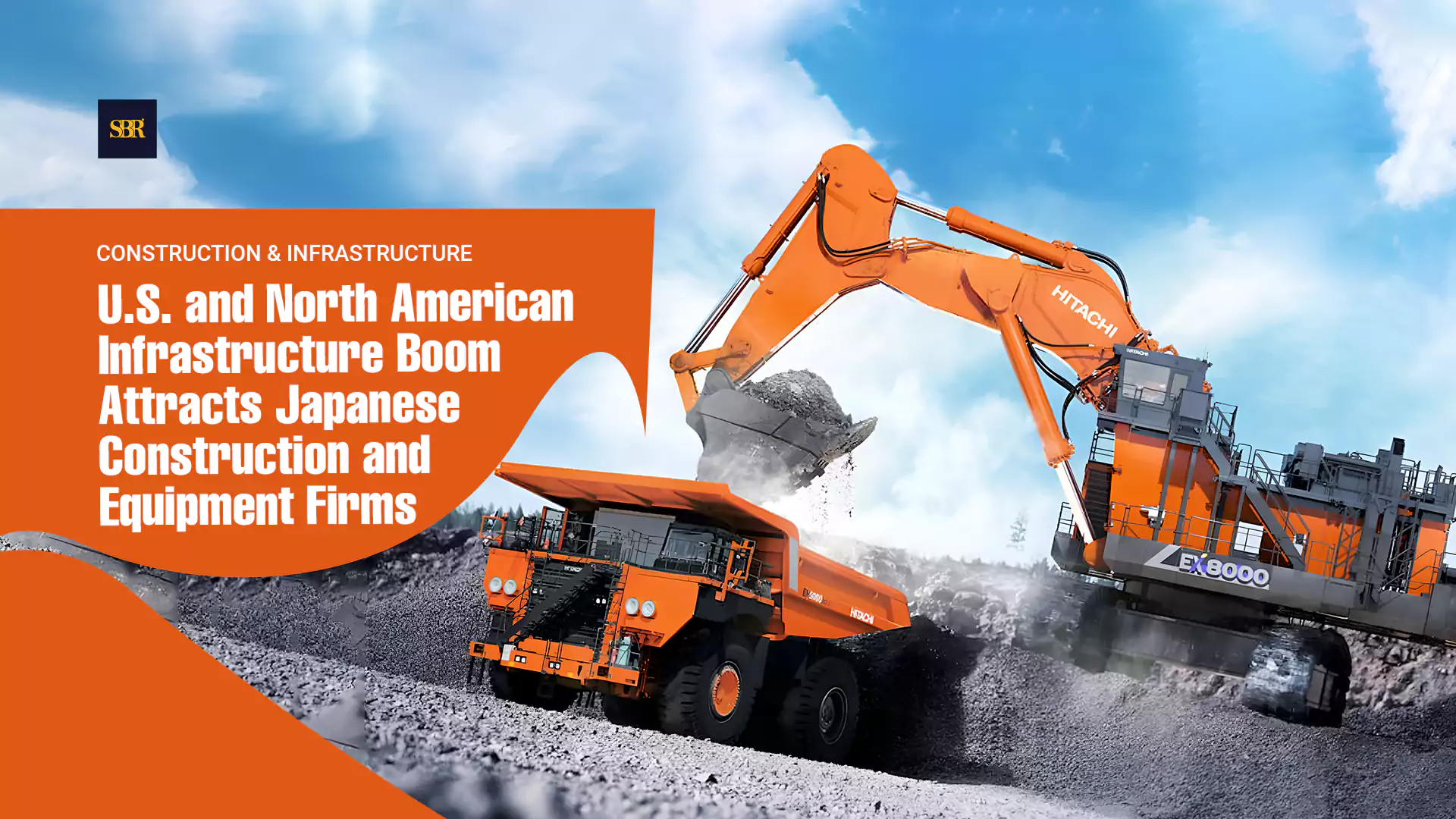
Hitachi’s US Product: Manufacturing of all of Hitachi’s equipment sold in the U.S. takes place in Japan. The company lowered its estimated tariff impact from $200 million to around $150 million following the announcement of the trade deal.
Despite no formal announcement, there is a growing possibility that Hitachi will invest in U.S. production, potentially including excavator assembly, within the next two years.
Industry experts suggest that Hitachi may not make an announcement for the next 12 to 24 months, but the big question is how Hitachi continues to have equipment 100 per cent exported from Japan.
The possible expansion of U.S. production is seen as a step in the right direction, as Hitachi gains global construction equipment market share. In 2024, the company overtook Volvo Construction Equipment to become the seventh-largest OEM by market share at 3.8 per cent, according to the KHL Group’s Yellow Table.
Construction Equipment Industry: The construction equipment market is projected to grow from $148.02 billion in 2024 to $186.62 billion by 2030 at a CAGR of 3.9 per cent, as per a recent study by MarketsandMarkets. The largest market share in the global construction equipment market in terms of value is likely to be with crawler excavators. These construction machines are designed for diverse terrains and heavy loads, making them a preferred choice for excavation, grading, and demolition.
An important breakthrough came in 2023 when Komatsu Co., Ltd. developed a concept machine for a medium-sized hydraulic excavator that combines a hydrogen fuel cell and Komatsu-developed key components to achieve carbon neutrality at workplaces using construction equipment.

Construction Machinery Orders Turn Positive for Japanese Manufacturers
Machinery orders for Japanese-made construction equipment increased strongly in the first two months of 2025, as per latest official figures.
Machinery orders in construction increased 14.1 per cent in February 2025, compared to the same month a year before, according to the Japanese Cabinet Office. That followed an 8.4 per cent increase in January 2025 and marked the second consecutive month of growth after two negative quarters of -17.3 per cent and -9.2 per cent in November and December 2024, respectively.
In May this year, Japanese construction, mining, forestry, and military heavy equipment maker Komatsu CEO Takuya Imayoshi said the company should see a nearly 20-billion-yen ($140 million) mitigation in the impact of U.S. tariffs on its bottom line after the U.S.-China trade truce, suggesting its outlook for lower profits may not be as bad as feared.
With more than one-quarter of Komatsu's sales coming from North America, the reduction in the tariff impact, a roughly 20 per cent easing in its forecast of a 94.3 billion yen hit from the tariffs, would have an outsized effect on its profit outlook.
In an interview with Reuters, Imayoshi, the head of the world's second-largest construction and mining machinery maker, did not say the company is officially revising its April forecast of a 27 per cent drop in current-year profit as a result of U.S. President Donald Trump's tariffs.
Hitachi is exploring U.S. production, with the possibility of including excavator assembly within the next two years.