By Andrew Pylypchuk, Global Director of Business Development for Agriculture, EarthDaily
VANCOUVER, March 16, 2026 — Agricultural retail is undergoing one of the most significant structural shifts in its history. Across global markets, retailers face a new competitive reality: success is no longer defined by reacting quickly to in-season conditions, but by seeing earlier, predicting more accurately, and making territory-wide decisions before growers even recognize the need. Pre-season planning has moved from a technical agronomic exercise to a central organizational discipline, customer loyalty, shaping margin, and increasing market share.
Across agriculture, industry leaders describe the same experiences: the sector has never been more dynamic, more complex, or more demanding. Once considered data-poor, agriculture is now awash in analytic solutions, soil sampling tests, weather models, machine telemetry and yield histories. Continuous streams of information across software systems have individually advanced capabilities significantly, but at a cost. More data has not created more stability; it has raised the bar for prioritization. Instead, a new risk has emerged: the gap between what can be observed and what can be acted on.
Few places reveal this gap more clearly than agricultural retail, where advisory responsibility, inventory exposure, and grower expectations intersect.
Retail agronomists today are covering more ground than they used to. As territories expand, retail agronomists are responsible for higher expectations to provide services on more acres, with more complexity, using more products and with fewer supporting resources. Advice built around individual fields is under increasing strain precisely because results are measured at territory scale.
For retailers, this timing risk becomes an inventory exposure. When demand shifts faster than ordering cycles, product sits in the wrong place at the wrong time or arrives after the application window has already closed. High value inputs become liabilities, tying up working capital and eroding margin. Retailers also carry reputational risk when conditions turn and supply can’t follow. As territories expand and variability increases, misaligned inventory costs rise sharply. Foresight matters: seeing stress build, crop stages advance, or acres shift even a week earlier gives retailers the lead time to position product intelligently, avoid over or under commitment, and protect margin and trust.
Globally, a third dimension of grower success is now rivaling productivity and grain marketing: risk management. Growers must navigate climate variability, biosecurity threats, global competition, market volatility, and rapidly changing consumer expectations. Retailers face the same reality. Risk competency, being able to anticipate variability and act early is becoming a core commercial capability that underpins organizational efficiency and customer trust.
This tension is most visible in retail territories where early variability reshapes pre-season assumptions faster than advisory cycles can adjust. Teams aren’t short of data; they are managing more signals within tighter decision windows. The advantage now belongs to retailers who convert early, territory level signals into timely, coordinated action.
Territory-Level Risk is the New Lens
As retail territories expand and production systems grow more variable, the core challenge facing agricultural retail is no longer the availability of data, but the ability to interpret territory wide patterns early enough to act on them. While agronomy has traditionally organized around individual fields, retail performance is measured across entire books of business—spanning regions, grower portfolios, product commitments, and margin exposure. Effective early season planning therefore requires understanding how stress will unfold across whole territories, not just isolated fields.
Variability must be assessed in relation to historical baselines, risk exposure must be evaluated across growers and geographies, and scarce agronomic time must be sequenced deliberately. In many regions, a quarter of preseason sales and agronomy plans can shift before planting is complete, driven by fast moving weather, soil moisture variability, uneven emergence, and early stress signals. When these shifts are detected too late, the consequences cascade: inventory tightens, conversations with growers become reactive, and margin exposure increases.
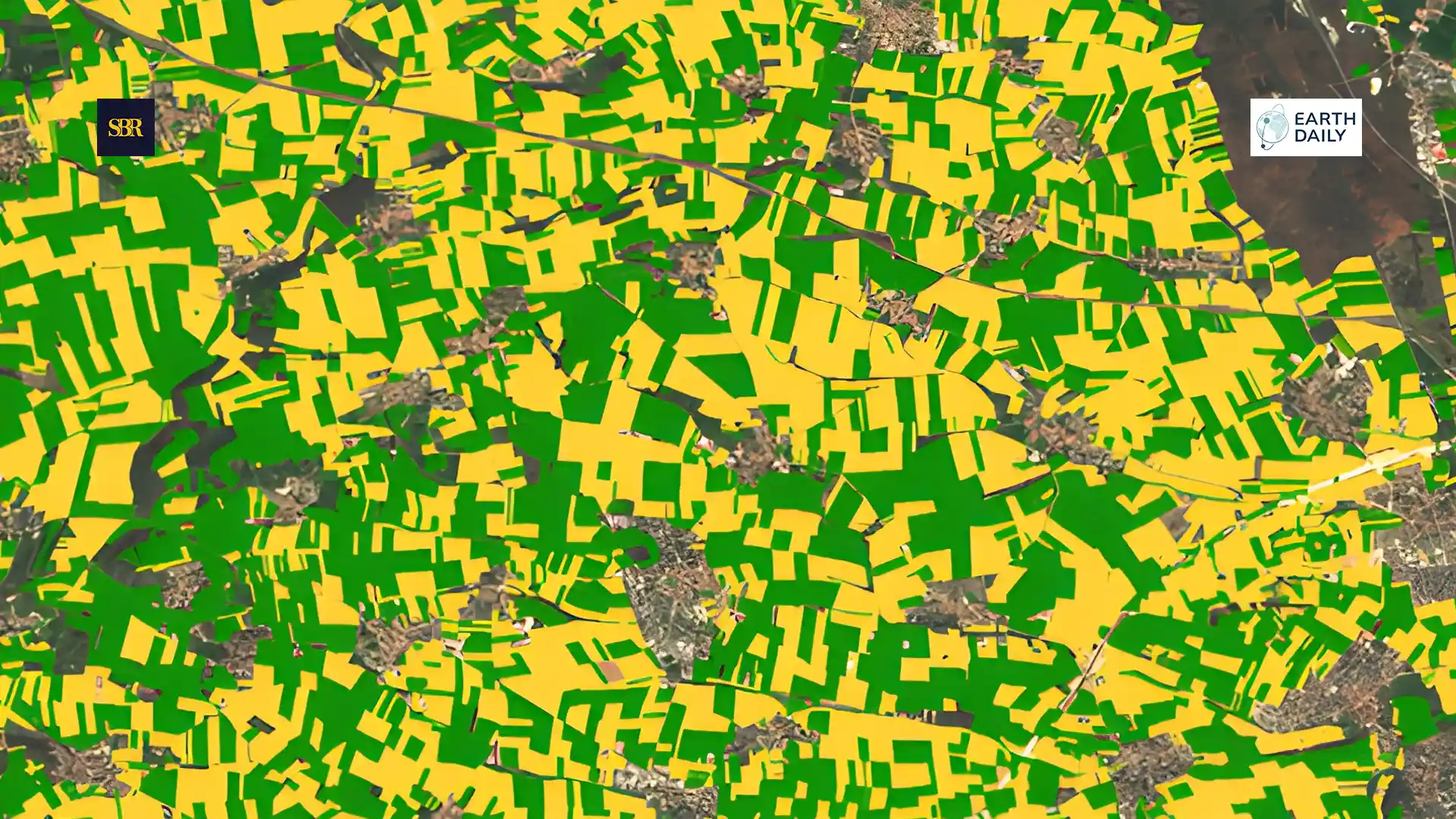
Predictive methods and tools address this structural challenge by providing consistent, territory wide signals of crop condition, yield potential, and emerging variability, long before those signals become visible in the field. Automated field boundary detection, crop identification, daily benchmarking, and forecasting of tasseling, stress emergence, nutrient deficiencies, and yield-limiting conditions allow retailers to see meaningful patterns before they become expensive problems. As satellite coverage accelerates and signal consistency improves, early variability becomes easier to detect at scale, allowing retailers to stabilize their advisory cycles and allocate resources proactively. This creates time, the single most scarce resource in modern retail agronomy.

Using low touch signals, EarthDaily’s Territory Insights uses consistent Earth Observation and weather baselines to identify key features of a location or area, enabling planning assumptions for actions such as tasselling window for fungicide application timing or crop rotation for cover cropping.
In this environment, the limiting factor is not information but time. Advisory teams responsible for thousands of fields need clarity on where to focus first. Without that foresight, plans drift, mid-season adjustments become more frequent, and both financial and relational costs rise. Territory level insight transforms this dynamic, turning planning into a commercial risk discipline that protects margin, strengthens customer engagement, and aligns decisions across the entire retail organization.
Prioritization as a Retail Constraint
Agricultural economies worldwide demonstrate that the most resilient growers are those who adapt fastest. Their ability to collaborate, problem-solve, and embrace new tools positions them to thrive amid unpredictability. Predictive intelligence amplifies this adaptability not only for growers but for retail organizations themselves. Automation shifts agronomic effort away from locating issues in the field: nutrient deficiencies, disease and pest pressures for example, and toward strengthening recommendations and coordinating action. It allows agronomists to scale expertise across thousands of fields, helps sales teams identify the highest-return opportunities, and empowers marketing teams to shift from calendar-based messaging to conditions-based activation.
The commercial impact is measurable. Retailers planning ahead, deploying Territory Insights have achieved more than 10% territory growth, expanded fungicide adoption from 8% to 30%, and added approximately five new customers per 50 managed. Sales teams are no longer guessing which growers to call or when to call them, the timing becomes visible, actionable, and sequenced across territories. Agronomy teams move from firefighting to proactive prioritization. And leadership gains stability in both planning and margin performance.
Yet the strategic value extends beyond operational efficiencies. Workforce shortages are becoming one of the most pressing concerns in agriculture. Retail advisory capacity has not expanded at the same pace as farm consolidation and expanding territories. OECD has noted similar constraints in agricultural knowledge and advisory systems. Fewer advisors are responsible for more acres, often across wider and more diverse geographies. Predictive tools allow teams to do more with limited expertise, protect advisor bandwidth, and reinforce long-term investment cycles by reducing uncertainty in planning.
Planning as a Competitive Discipline
Agronomy will continue to rely on local knowledge and human judgment. The most important shift is conceptual. Planning is no longer a forecast, it is a dynamic process for managing variability at scale, managing risk at scale. Retailers who see patterns earlier stabilize advisory cycles, reduce margin surprises, improve inventory positioning, and elevate the quality of grower interactions. In contrast, retailers who wait for field visibility before acting find themselves in compressed, competitive, and costly situations. And for growers, the clarity allows them to see the plan, have time to manage changes and make confident decisions with their retail partners.
In a world of accelerating agritech, expanding sustainability demands, and heightened climate variability, data alone is no longer the differentiator. Foresight is. Retailers equipped with consistent, territory-wide early signals can align agronomy, sales, marketing, and operations in ways reactive organizations cannot match.
Imperatives for the Next Era of Agricultural Retail
For leadership teams across agricultural retail, the message is unmistakable: your next competitive advantage begins weeks earlier than it used to. Seasonal planning has become a commercial risk discipline and those who master it gain a durable edge in growth, margin protection, and customer loyalty. Retail success now starts earlier. With predictive foresight, retailers don’t just respond faster, they lead before the season even begins.
As early season foresight becomes a core competitive advantage, retail leadership faces a new mandate: shift from reactive field level decisions to predictive, territory scale strategy. Modern agronomy moves too quickly for traditional planning. Leaders must adopt systems that surface early signals — yield potential, emerging stress, timing windows — before variability is visible, and use those insights to shape inventory, staffing, marketing, and grower engagement. Time has become retail’s scarcest resource, and leadership must reorient teams around when to act, not just what to do.
Performance is now measured across portfolios and regions, demanding unified data, aligned teams, and consistent visibility at scale. As agritech, analytics, and automation accelerate, leadership must evolve the organization accordingly. Predictive intelligence is the lever that moves retailers from reacting to leading — reducing risk, strengthening margins, and deepening customer loyalty.
Advisory teams responsible for thousands of fields need clarity on where to focus first. Without that foresight, plans drift, mid-season adjustments become more frequent, and both financial and relational costs rise. Territory level insight transforms this dynamic, turning planning into a commercial risk discipline that protects margin, strengthens customer engagement, and aligns decisions across the entire retail organization.
About Andrew Pylypchuk
Andrew Pylypchuk leads agricultural business development at EarthDaily, where he works on applying Earth observation data to real-world agricultural decision-making across markets, risk, and climate-driven systems.











.webp)